Electronics do not heat up in a neat, steady way. They spike, cool, and spike again. That makes thermal management hard, because a material that is helpful in one moment may be unhelpful in the next.
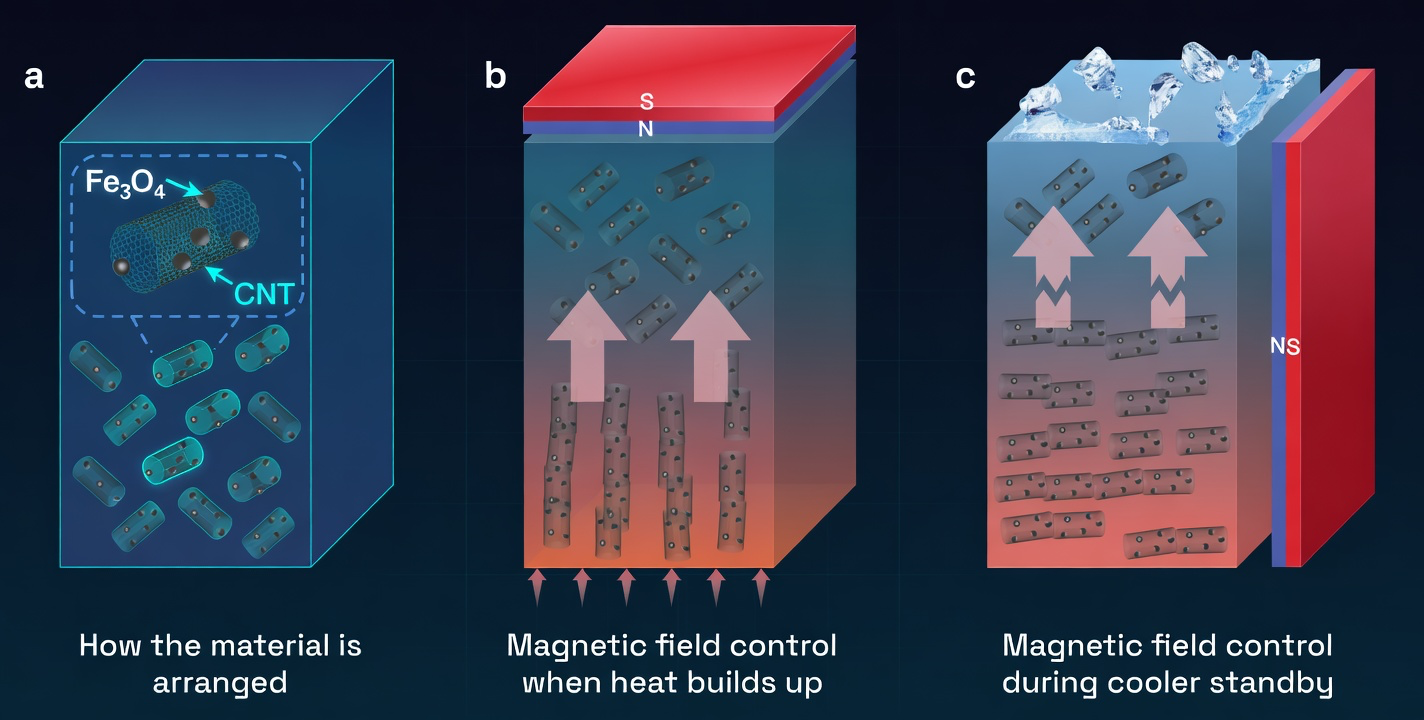
This paper describes a way to tune that behavior with a magnetic field. The researchers built a phase-change material based on n-eicosane and tiny Fe3O4-coated carbon nanotubes. When the material melts, those particles can rotate and line up differently under a magnetic field. That changes how easily heat moves through the material.
In the lab, the team used that effect to switch the same material between a more heat-spreading state and a more insulating state. The key control was the angle between the magnetic field and the main heat-flow direction. In their tests, that changed the material’s effective thermal resistance by about a factor of 1.8.
Why does that matter? Because variable devices do not always need the same thermal response. Sometimes you want heat to move away quickly during a power burst. Sometimes you want the system to hold heat back so temperatures do not swing too sharply during standby or intermittent operation.
The paper reports that, in its tested electronic setup, magnetic-field regulation reduced temperature excursions by up to 10.8 °C compared with the same composite material without that regulation. That is a meaningful lab result. But it is still a lab result. It does not mean the method is ready to solve overheating across real products.
Another boundary matters too: the tuning works mainly when the phase-change material is in its melted state. Once it solidifies, the particle arrangement is effectively locked in until the material melts again.
So the real takeaway is narrower and more useful than the hype version. This study shows that a thermal-management material can be actively reconfigured with a magnetic field under changing operating conditions. That could be a useful design idea for future heat-management systems, but it is not yet a ready-made fix for every hot device.